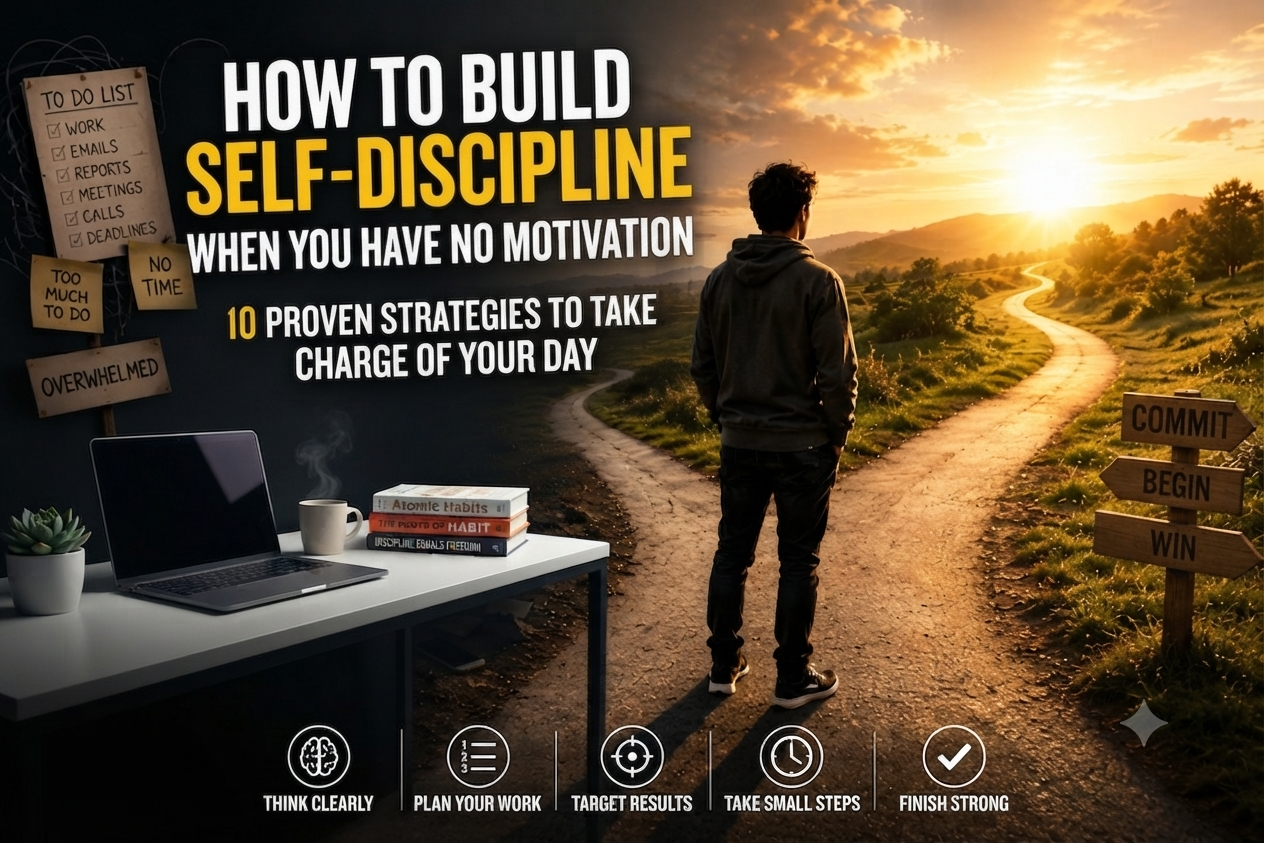
There are days when you genuinely want to change your life, but you simply don't feel motivated.
You plan to wake up early, exercise, study, work on your goals, or finally finish something you've been putting off. Then the day arrives, your motivation disappears, and you tell yourself you'll start tomorrow.
The problem is that motivation is unreliable.
If you want to make lasting changes, you need something that works even when you don't feel like doing the work.
That is where self-discipline comes in.
Self-discipline doesn't mean forcing yourself to work hard every minute of the day. It means learning how to take the actions that matter even when your feelings are telling you to do something easier.
In this guide, you'll learn how to build self-discipline when you have little or no motivation, how to make discipline easier, and how to stop relying on motivation to get things done.
What Is Self-Discipline?
Self-discipline is the ability to follow through on an important action even when you don't feel like doing it.
For example:
-
You exercise even when you aren't motivated.
-
You work on an important project instead of scrolling on your phone.
-
You study when you'd rather watch something.
-
You keep a promise you made to yourself.
-
You finish a task even after the initial excitement disappears.
Self-discipline is not about being perfect.
It's about repeatedly choosing what is important over what is immediately comfortable.
And the good news is that self-discipline isn't something you're simply born with. It can be developed through repeated practice.
Why You Can't Rely on Motivation

Motivation feels powerful when you have it.
You might watch an inspiring video, make a big plan, and suddenly feel ready to completely change your life.
But motivation naturally goes up and down.
One day you may feel extremely motivated. The next day you may feel tired, distracted, stressed, or completely uninterested.
If your actions depend entirely on motivation, your progress will depend on your mood.
That's why you shouldn't ask yourself:
"Do I feel motivated today?"
A better question is:
"What is the smallest useful action I can take today?"
That shift can make a huge difference.
Start With One Small Promise
One of the easiest ways to build self-discipline is to stop making huge promises to yourself.
Instead of saying:
-
"I'll exercise for two hours every day."
-
"I'll wake up at 5 AM from tomorrow."
-
"I'll study for five hours every day."
-
"I'll completely change my life this month."
Start smaller.
For example:
-
Walk for 10 minutes.
-
Read two pages.
-
Work for 15 minutes.
-
Clean one small area.
-
Write 100 words.
-
Do five push-ups.
The goal isn't to impress yourself with a huge plan.
The goal is to prove to yourself that you can follow through.
If you frequently promise yourself that you'll change but then don't follow through, you may also want to read How to Stop Breaking Promises to Yourself.
Every time you keep a small promise, you create evidence that you can trust yourself.
Over time, those small wins can become the foundation of stronger self-discipline.
Make the Habit So Easy That You Can't Avoid It
When you're trying to build discipline, don't make the first step unnecessarily difficult.
If your goal is to exercise, don't begin with an unrealistic workout.
If your goal is to read, don't force yourself to read 50 pages.
If your goal is to write, don't demand 2,000 words from yourself.
Make the starting point easy.
Tell yourself:
"I'll do this for just five minutes."
Five minutes doesn't sound intimidating.
And once you begin, you may naturally continue.
But even if you stop after five minutes, you still kept your commitment.
That's important because you're training the habit of starting.
Use Rules Instead of Feelings
People who struggle with consistency often negotiate with themselves.
They think:
"I'll do it later."
Then:
"I'm tired today."
Then:
"I'll start tomorrow."
Eventually, the day is over.
One way to reduce this problem is to create simple rules.
For example:
Instead of:
"I'll exercise when I feel motivated."
Use:
"I'll exercise for 10 minutes after breakfast."
Instead of:
"I'll work on my project sometime today."
Use:
"I'll work on it from 7:00 to 7:30 PM."
The more decisions you remove, the easier it becomes to act.
You don't need to constantly decide whether you should do the habit.
You've already decided.
Remove Temptations Before You Need Discipline
Sometimes the problem isn't that you have weak discipline.
Your environment may simply be making the wrong behavior too easy.
If your phone is next to you while you're trying to work, you'll probably check it.
If junk food is always available, you'll probably eat it.
If your television is on while you're studying, your attention will be divided.
Instead of constantly fighting temptation, change your environment.
Try:
-
Put your phone in another room while working.
-
Turn off unnecessary notifications.
-
Keep your workout clothes ready.
-
Keep your book on your desk.
-
Block distracting websites during focused work.
-
Prepare tomorrow's tasks the night before.
Good habits become easier when your environment supports them.
Focus on Starting, Not Finishing
A common mistake is thinking about the entire task before starting.
Imagine you need to write a 2,000-word article.
Thinking about 2,000 words can feel overwhelming.
Instead, focus on opening the document and writing the first sentence.
Once you've started, the task usually feels less intimidating.
This principle applies to almost anything:
Don't focus on the entire mountain. Focus on the next step.
If feeling overwhelmed is one of the main reasons you avoid important tasks, read How to Stop Procrastinating When You're Overwhelmed.
The goal is not to eliminate every uncomfortable feeling before taking action.
The goal is to learn that you can act despite discomfort.
Create a Minimum Version of Your Habit
Life won't always go according to plan.
You may have a bad night's sleep, an unexpected responsibility, or a stressful day.
If your habit only works on perfect days, you'll eventually abandon it.
Instead, create a minimum version.
For example:
Normal workout: 30 minutes
Minimum workout: 5 minutes
Normal reading: 20 pages
Minimum reading: 2 pages
Normal writing: 1,000 words
Minimum writing: 100 words
Normal study session: 60 minutes
Minimum study session: 10 minutes
The minimum version keeps the habit alive when life gets difficult.
You don't need to win every day.
You need to avoid completely giving up.
Stop Trying to Change Everything at Once
Another reason people struggle with discipline is that they try to rebuild their entire life overnight.
They decide to:
-
wake up early
-
exercise
-
eat perfectly
-
read every day
-
meditate
-
learn a new skill
-
start a business
-
stop using social media
-
work eight hours
-
sleep early
All at once.
It sounds productive.
But it can quickly become exhausting.
Instead, choose one or two behaviors that would make the biggest difference.
Build those first.
Once they become easier, add another.
Discipline grows through consistency, not through creating the biggest possible to-do list.
Don't Quit Because You Miss One Day
Missing one day doesn't destroy your progress.
The bigger problem is turning one missed day into a week, then a month.
Maybe you planned to exercise Monday through Friday but missed Monday.
That doesn't mean:
"I've failed."
It means:
"Monday didn't happen. I'll continue Tuesday."
This mindset is extremely important.
You don't need an unbroken streak to build discipline.
You need the ability to return after you slip.
If you regularly start things with enthusiasm but eventually abandon them, read How to Stop Quitting Everything You Start.
Learning how to restart quickly is one of the most valuable parts of becoming disciplined.
Keep Track of Your Promises
A simple tracking system can make your progress visible.
You can use a notebook, calendar, spreadsheet, or habit tracker.
For example:
| Day | 10-Minute Workout | Reading | Important Task |
|---|---|---|---|
| Monday | ✓ | ✓ | ✓ |
| Tuesday | ✓ | ✓ | ✓ |
| Wednesday | ✓ | — | ✓ |
| Thursday | ✓ | ✓ | ✓ |
| Friday | ✓ | ✓ | — |
You don't need a complicated productivity system.
You just need a way to see whether you're doing what you said you would do.
Tracking also gives you an opportunity to notice patterns.
Maybe you're consistent in the morning but struggle at night.
Maybe you procrastinate when tasks are unclear.
Maybe you lose discipline when you're tired.
Once you identify the pattern, you can change the system.
Use the "Just Five Minutes" Rule
When you don't feel like doing something, commit to doing it for only five minutes.
Set a timer.
Start.
You don't need to promise yourself that you'll finish the entire task.
You only need to promise yourself that you'll begin.
After five minutes, you can decide whether to continue.
Often, starting removes much of the resistance you felt before beginning.
And if you genuinely stop after five minutes, that's okay.
You still practiced self-discipline.
Reward Yourself for Following Through
Discipline doesn't mean making your life miserable.
It's okay to reward yourself when you complete something important.

After finishing a focused work session, you might:
-
take a short walk
-
listen to music
-
have a cup of tea
-
spend some time with family
-
watch an episode of a show
-
relax for a while
The key is to make the reward come after the important behavior rather than replacing it.
You are teaching your brain:
"When I take action, I get something enjoyable afterward."
Don't Wait to Feel Like It
This is perhaps the most important lesson.
You will not always feel motivated.
You will not always feel confident.
You will not always feel energetic.
You will sometimes feel bored.
You will sometimes want to quit.
You will sometimes want to procrastinate.
That's normal.
Self-discipline isn't the absence of these feelings.
Self-discipline is learning to act even when those feelings are present.
You don't have to feel ready.
You can start while feeling unmotivated.
What to Do When You Completely Lose Motivation
There will be days when even your smallest habit feels difficult.
On those days, use this simple process:
1. Stop thinking about the whole goal
Don't think about losing 20 kilograms, writing an entire book, building a business, or changing your entire life.
Think about today's action.
2. Make the task smaller
If 30 minutes feels impossible, do 5.
If 10 pages feels difficult, read one.
If writing 1,000 words feels overwhelming, write 50.
3. Remove one distraction
Put your phone away.
Close unnecessary tabs.
Leave the room where you're being distracted.
4. Start a timer
Give yourself five or ten minutes.
5. Begin before you feel ready
Action often creates motivation.
You don't always need motivation before action.
Sometimes action comes first, and motivation follows.
Build Discipline Through Identity
Eventually, you want discipline to become part of how you see yourself.
Instead of saying:
"I'm trying to become disciplined."
Start thinking:
"I'm someone who follows through."
Instead of:
"I need motivation to exercise."
Think:
"I exercise because that's something I do."
This isn't about pretending you're already perfect.
It's about repeatedly giving yourself evidence that your actions match the person you want to become.
Every small promise you keep strengthens that identity.
Every time you start instead of procrastinating, you strengthen it.
Every time you continue instead of quitting, you strengthen it.
A Simple 7-Day Self-Discipline Challenge
If you don't know where to start, try this for the next seven days.

Day 1: Choose one habit
Pick one behavior that matters to you.
Make it small.
Day 2: Create a specific time
Decide exactly when you'll do it.
Day 3: Remove one distraction
Change your environment to make the habit easier.
Day 4: Use the five-minute rule
Start even if you don't feel motivated.
Day 5: Track your progress
Mark whether you followed through.
Day 6: Practice your minimum version
Do the smallest acceptable version of the habit.
Day 7: Review the week
Ask yourself:
-
What worked?
-
What made the habit difficult?
-
When was I most consistent?
-
What distracted me?
-
What should I change next week?
Then repeat the process.
You don't need to completely transform your life in seven days.
You are simply practicing the skill of following through.
Final Thoughts
Building self-discipline when you have no motivation isn't about becoming a completely different person overnight.
It's about making smaller promises and keeping them.
It's about starting when you don't feel ready.
It's about creating an environment that makes good choices easier.
It's about continuing after you miss a day.
And most importantly, it's about learning that you don't have to wait for motivation before taking action.
Start with one small commitment today.
Keep it.
Then do it again tomorrow.
Over time, those small actions can become habits, those habits can become consistency, and that consistency can change the way you see yourself.
You don't need more motivation to begin. You need one small action you are willing to take today.
Keep Reading
If you're working on becoming more consistent and disciplined, these articles can help:
-
How to Stop Breaking Promises to Yourself — Learn how to rebuild trust in yourself by following through on the commitments you make.
-
How to Stop Quitting Everything You Start — Learn why you keep abandoning goals and how to develop the ability to keep going.
-
How to Stop Procrastinating When You're Overwhelmed — Learn how to take action when a task feels too large or difficult to begin.
Comments (0)
No comments yet. Be the first to share your thoughts!