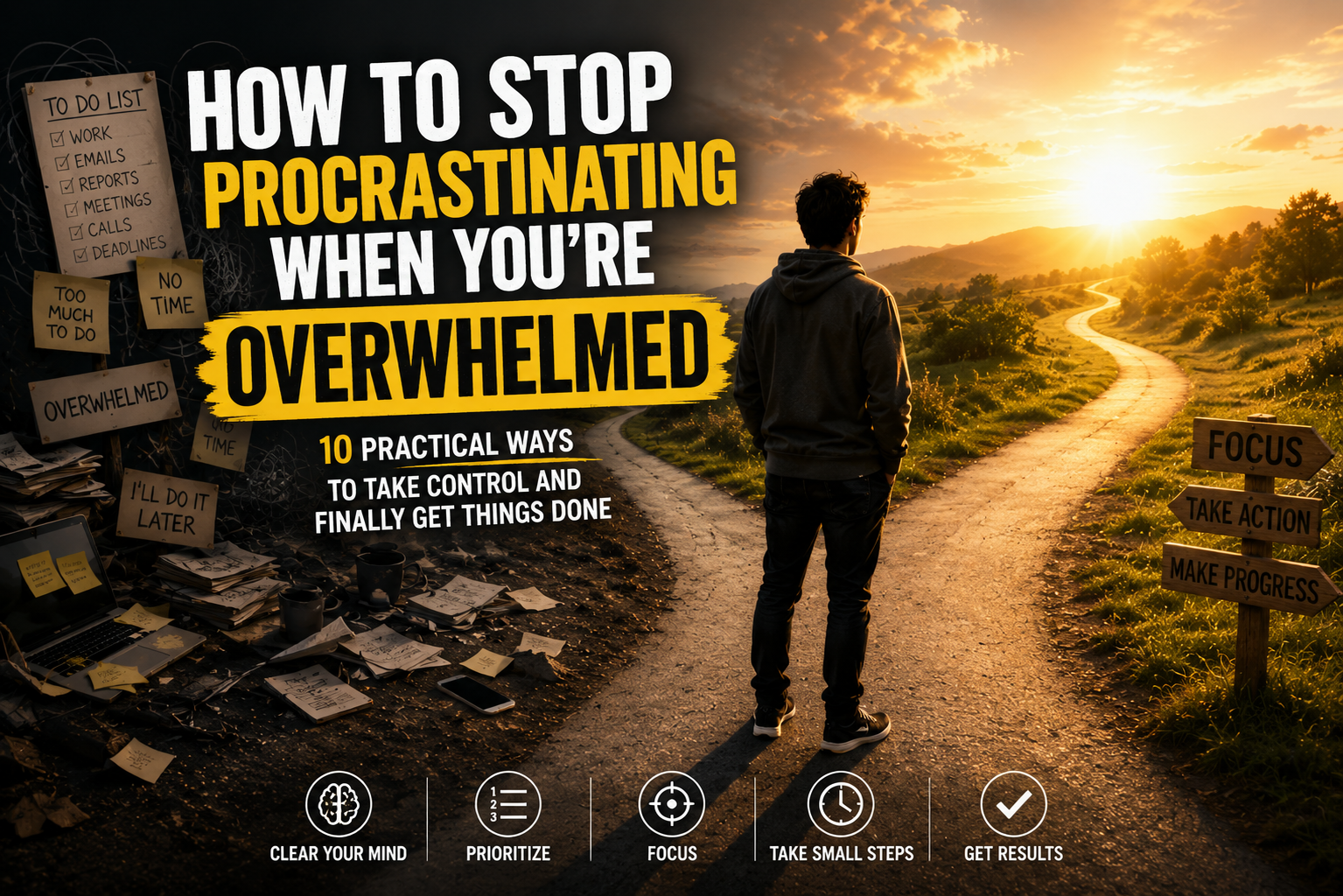
You have things to do.
Maybe too many things.
Your messages are unanswered. Your work is unfinished. Your room needs cleaning. Bills need attention. You have personal goals you've been ignoring. There are emails, deadlines, responsibilities and decisions waiting for you.
You know you should start.
But you don't.
Instead, you check your phone.
You watch a video.
You scroll through social media.
You tell yourself you'll start after lunch.
Then evening comes.
You haven't done much, and now you feel even worse.
The next day, the cycle starts again.
If this sounds familiar, you may not be procrastinating because you're lazy.
You may be overwhelmed.
When everything feels important at the same time, even a simple task can feel difficult to begin. Research on procrastination also points to factors such as stress, perfectionism, decision difficulty and feeling overwhelmed as contributors to delaying tasks.
The solution isn't to force yourself to suddenly become extremely productive.
The solution is to reduce the feeling of overwhelm and make starting easier.
Here's how.
Why Do You Procrastinate When You're Overwhelmed?

Procrastination often becomes worse when a task creates uncomfortable emotions.
You might feel:
-
Anxiety
-
Confusion
-
Fear of failure
-
Pressure
-
Boredom
-
Self-doubt
-
Perfectionism
-
Mental exhaustion
When you have one small task, starting may be easy.
But when you have twenty tasks competing for your attention, your brain doesn't know where to begin.
So you avoid beginning altogether.
This creates a dangerous cycle:
Too many tasks → overwhelm → avoidance → temporary relief → more unfinished tasks → greater overwhelm
The more you avoid, the bigger the problem appears.
And the bigger it appears, the harder it becomes to start.
Procrastination can also become a habit when you repeatedly avoid things you promised yourself you'd do. If you're struggling with that pattern, read How to Stop Breaking Promises to Yourself to learn how to rebuild trust with yourself.
The Goal Isn't to Finish Everything
This is one of the biggest mistakes people make when they're overwhelmed.
They look at their enormous list and think:
“I need to get everything done.”
You don't.
You need to decide what matters most right now.
You don't solve overwhelm by doing 30 things simultaneously.
You solve it by reducing 30 decisions down to one.
Sometimes procrastination is part of a larger cycle: you start something, lose motivation when it becomes difficult, and eventually abandon it. If that sounds familiar, read How to Stop Quitting Everything You Start next.
1. Stop and Do a Brain Dump

When everything is floating around inside your head, your brain keeps trying to remember everything.
Get it out.
Take a piece of paper or open a notes app.
Write down everything bothering you.
Don't organize it yet.
Write:
-
Work
-
Bills
-
Calls
-
Emails
-
Cleaning
-
Exercise
-
Personal projects
-
Shopping
-
Appointments
-
Things you've been avoiding
Get everything out of your head.
You are not creating a perfect productivity system.
You're simply removing mental clutter.
Why a Brain Dump Helps
When you can see everything in front of you, the situation often looks more manageable.
Instead of:
“I have so much to do.”
you now have:
“These are the things I need to deal with.”
That's a significant difference.
2. Choose Only Three Priorities

Now look at your list.
Ask:
“What are the three things that would make today successful?”
Not ten.
Three.
For example:
-
Pay electricity bill
-
Finish work report
-
Call customer
Everything else becomes secondary.
This prevents your entire day from becoming a battle against an endless to-do list.
3. Choose One Task to Start
Now comes the most important part.
Choose one.
Not the entire project.
Not your entire workload.
One task.
If you have to write a report, don't write:
“Finish report.”
Write:
“Open the document and write the first paragraph.”
If you need to clean your room, don't write:
“Clean room.”
Write:
“Put the clothes on the bed into the cupboard.”
Make the first action obvious.
4. Make the Task Ridiculously Small
Overwhelm makes big tasks feel threatening.
So shrink them.
Instead of:
Start my business
try:
Write down three services I could sell.
Instead of:
Get fit
try:
Put on my shoes and walk for 10 minutes.
Instead of:
Study for my exam
try:
Open the textbook and study one page.
Instead of:
Write an article
try:
Write the headline and first paragraph.
The goal is not to finish everything immediately.
The goal is to create movement.
5. Use the Five-Minute Rule
When you can't start, make the commitment smaller.
Tell yourself:
“I only have to do this for five minutes.”
Set a timer.
Work for five minutes.
You don't have to promise yourself that you'll work for three hours.
You only have to start.
The five-minute approach is widely used in practical approaches to overcoming overwhelm because it reduces the psychological barrier to beginning.
After five minutes, you have two choices:
Continue or stop.
If you stop, that's okay.
You still broke the avoidance cycle.
Often, however, once you've started, continuing feels easier.
6. Remove the First Distraction
Sometimes the problem isn't the task.
It's what's immediately available instead.
Your phone is next to you.
Social media is one tap away.
Notifications keep appearing.
You have 15 browser tabs open.
Make starting easier by making distraction harder.
Put your phone in another room.
Close unnecessary tabs.
Turn off notifications.
Clear your desk.
Then start the smallest task.
You don't need extraordinary willpower if you've already removed some of the temptation.
7. Don't Try to Do Everything Perfectly

Perfectionism can disguise itself as procrastination.
You tell yourself:
“I'll start when I have enough time.”
Or:
“I'll do it properly tomorrow.”
Or:
“I need to figure everything out first.”
The result?
You don't start.
Instead, allow yourself to create a bad first version.
Write the bad draft.
Make the imperfect plan.
Do the basic workout.
Create the rough design.
You can improve something that exists.
You can't improve something you never started.
Progress Before Perfection
Use this rule:
First make it exist. Then make it better.
That applies to writing, business, studying, fitness, content creation and almost everything else.
8. Decide What You Can Ignore
This is something productivity advice often misses.
When you're overwhelmed, you don't necessarily need a better way to complete everything.
Sometimes you need to do fewer things.
Look at your list and ask:
What can I delete?
What can I postpone?
What can I delegate?
What doesn't actually matter?
What would happen if I simply didn't do this?
Not everything deserves your attention today.
Some tasks are urgent.
Some are important.
Some are merely noisy.
Learn the difference.
9. Use “Next Action” Instead of “Big Goal”
Big goals can create anxiety because they're abstract.
“Build a successful business” is huge.
“Find one potential customer” is concrete.
“Write a book” is huge.
“Write 300 words” is concrete.
“Get my life together” is huge.
“Clean my desk” is concrete.
Whenever you feel overwhelmed, ask:
“What is the next physical action?”
Not:
“How am I going to solve my entire life?”
Just:
“What can I physically do next?”
10. Give Yourself Permission to Take a Break
Being overwhelmed doesn't mean you need to work harder every second.
Sometimes you're mentally exhausted.
A short, intentional break can help you step back and prioritize instead of reacting to everything at once. Psychology Today similarly recommends pausing to assess urgency and regain perspective when you're overwhelmed by competing demands.
But make your break intentional.
Instead of:
“I'll just check Instagram for five minutes.”
which can easily become an hour,
try:
“I'm taking a 15-minute break. Then I'll return and complete one task.”
A break should help you return.
It shouldn't become an escape.
The 15-Minute Overwhelm Reset
When you're completely stuck, use this process.
Minute 1–3: Brain Dump
Write down everything on your mind.
Minute 4–5: Choose Three Priorities
Decide what actually matters today.
Minute 6–7: Choose One Task
Pick the first thing you're going to do.
Minute 8: Shrink It
Turn it into the smallest possible action.
Minute 9–10: Remove Distractions
Put away your phone and close unnecessary apps.
Minute 11–15: Start
Work on the task.
That's it.
You don't need to solve your entire life in 15 minutes.
You simply need to move from overwhelmed → moving.
What If Everything Feels Urgent?
This is a common problem.
You look at your list and think:
“Everything needs to be done now.”
Usually, that's not literally true.
Ask four questions:
What has a real deadline?
What has consequences if I don't do it today?
What can wait until tomorrow?
What can be ignored completely?
Then act accordingly.
If something genuinely has an urgent deadline, deal with it first.
But don't let the feeling of urgency make every task equally important.
What If You Keep Procrastinating After Making a Plan?
Then the plan may still be too big.
Suppose you write:
“Work on business.”
That's not a clear action.
Your brain still has to decide:
What should I do?
Where should I start?
What should I research?
What should I write?
Who should I contact?
Instead write:
“Open my customer list and call the first person.”
Now there is nothing to figure out.
You simply do it.
The more specific the next action, the less mental resistance you create.
Don't Wait for Motivation
One of the biggest traps is waiting until you feel ready.
You may think:
“I'll start when I feel motivated.”
But motivation often comes after action.
You begin.
You make progress.
You feel a little better.
Then you become more willing to continue.
So don't ask:
“Do I feel motivated?”
Ask:
“What is the smallest thing I can do right now?”
What to Do When You Feel Completely Frozen
Sometimes even five minutes feels impossible.
If that's where you are, go even smaller.
Don't start the project.
Just:
Stand up.
Then:
Put your phone down.
Then:
Open the document.
Then:
Write one sentence.
That's enough.
The first objective is not productivity.
It's breaking the freeze.
A Simple Rule: One Thing at a Time
When you're overwhelmed, multitasking feels attractive.
You think:
“I'll answer emails while watching a video and plan tomorrow.”
But switching between tasks increases mental friction.
Instead:
One task.
One screen.
One short period of focused work.
Then take a break.
Then choose the next task.
You don't need to control the entire day at once.
You only need to control the next few minutes.
How to Prevent Overwhelm Tomorrow

The best way to deal with overwhelm is to prevent your task list from becoming unmanageable in the first place.
Every evening, take five minutes.
Write down:
Tomorrow's Most Important Task
Then write:
Second Priority
Then:
Third Priority
Stop there.
You can have a larger task list elsewhere, but your daily focus should remain small.
When you wake up, you shouldn't have to ask:
“What should I do?”
You already decided.
The Difference Between Laziness and Overwhelm
It's easy to call yourself lazy when you're avoiding work.
But sometimes you're not lazy.
You're overloaded.
There's too much uncertainty.
Too many decisions.
Too many unfinished tasks.
Too much pressure.
Calling yourself lazy doesn't solve any of those problems.
Understanding what's actually happening gives you something you can work with.
Instead of:
“I'm lazy.”
try:
“I'm overwhelmed, so I'm going to reduce the task.”
That gives you a next step.
Your Emergency Anti-Procrastination Formula
Save this formula:
STOP → DUMP → PRIORITIZE → SHRINK → START
STOP
Stop trying to do everything simultaneously.
DUMP
Write everything down.
PRIORITIZE
Choose the three things that matter most.
SHRINK
Turn the first task into a tiny action.
START
Work for five minutes.
Repeat.
That's your way out.
Final Thought

When you're overwhelmed, your brain wants you to escape.
That's why procrastination can feel so comforting in the moment.
You avoid the task.
You feel temporary relief.
But later, the task is still there—and now you've added guilt and pressure to it.
The way out isn't to suddenly become a completely different person.
You don't need perfect discipline.
You don't need unlimited motivation.
You don't need to finish everything today.
You need to make the next step smaller.
Put the phone away.
Write down what's bothering you.
Choose one priority.
Break it into a tiny action.
Work for five minutes.
Then decide what comes next.
You don't have to climb the entire mountain today.
You just have to take the next step.
Frequently Asked Questions
Why do I procrastinate when I'm overwhelmed?
Overwhelm can make tasks feel too large, unclear or emotionally uncomfortable. Avoiding them provides temporary relief, but the unfinished work can increase stress and make the next attempt harder.
How do I stop procrastinating when I have too much to do?
Write everything down, choose your three most important priorities, and work on only one task at a time. Break the first task into a small physical action and start with five minutes.
Is procrastination caused by laziness?
Not necessarily. Procrastination can be associated with emotional discomfort, stress, perfectionism, decision difficulty and feeling overwhelmed.
What is the five-minute rule?
The five-minute rule means committing to work on an avoided task for only five minutes. The purpose is to make starting feel manageable rather than requiring yourself to finish the entire task.
What should I do when everything feels urgent?
Pause and determine which tasks have genuine deadlines or serious consequences. Prioritize those first and deliberately postpone, delegate or remove tasks that don't require immediate attention.
How can I stop procrastinating permanently?
Don't focus on eliminating procrastination forever. Build a system that makes starting easier: reduce task size, remove distractions, clarify the next action, prioritize fewer things and return quickly when you fall off track.
What if I procrastinated all day?
Don't wait until tomorrow.
Pick one tiny task and work on it for five minutes.
A bad day doesn't need to become a bad week.
Start again now.
Comments (0)
No comments yet. Be the first to share your thoughts!