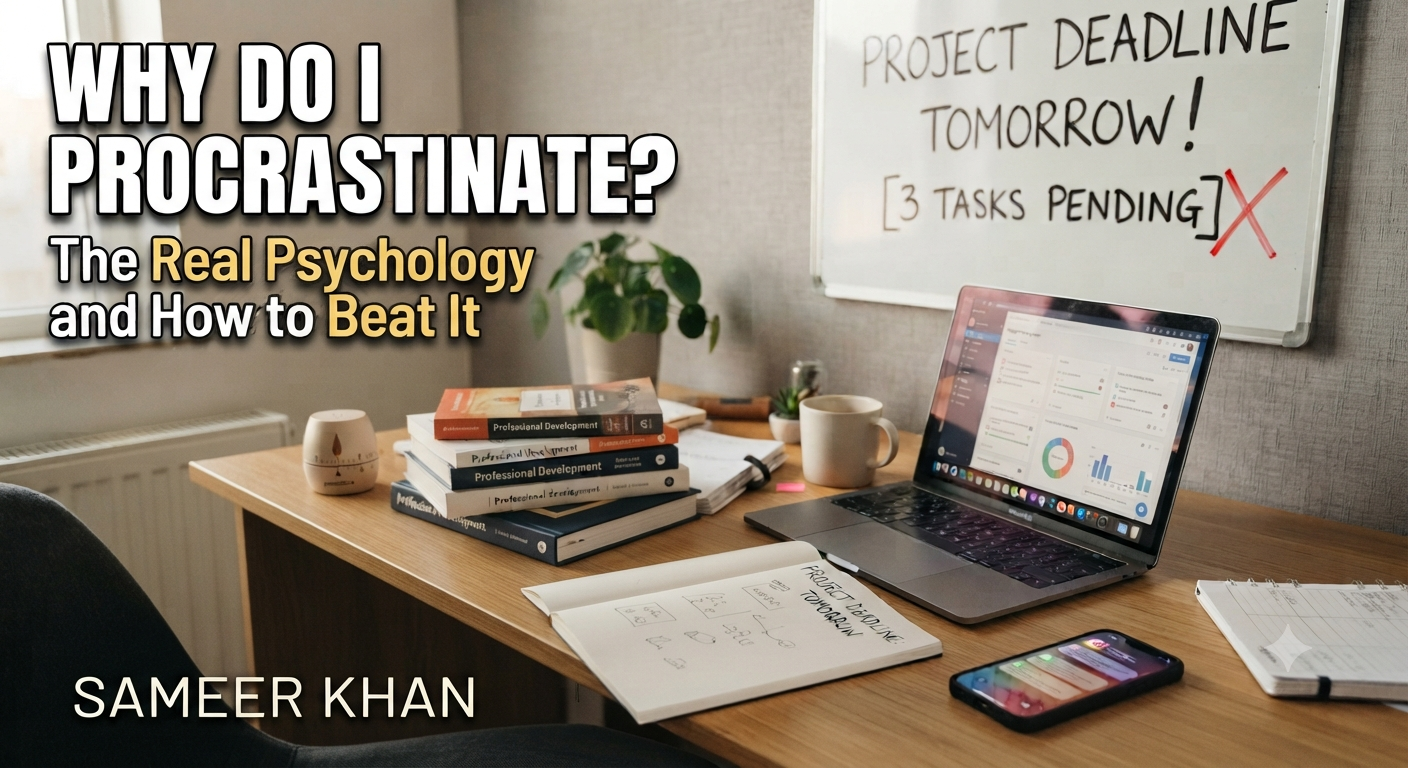
Have you ever stared at a blank screen, knowing full well you have a critical project due in a few hours, yet somehow found yourself deep-cleaning your kitchen, organizing your desk by color, or scrolling endlessly through social media? If your answer is a resounding yes, welcome to the club. You are not alone, and more importantly, you are not inherently lazy.
How to Maintain Consistency and Discipline
Procrastination is one of the most universal human struggles. Millions of people battle the urge to delay important tasks every single day. Yet, whenever we catch ourselves doing it, our immediate reaction is harsh self-criticism. We call ourselves lazy, undisciplined, or broken. But here is the truth: procrastination is rarely a time-management problem. It is an emotional regulation problem.
If you have ever asked yourself, "Why do I procrastinate even when I know it ruins my peace of mind?"—this deep dive is for you. Let's unpack the real psychological mechanics behind why we delay, why logic doesn't fix it, and what you can actually do to overcome it starting today.
The Root Cause: It's Not Laziness, It's Emotional Regulation
For decades, society viewed procrastination through a lens of poor time management. The assumption was simple: if you just learned how to use a planner or time-block your day, you would stop procrastinating. But modern psychological research tells a completely different story.
Dr. Tim Pychyl and Dr. Fuschia Sirois, leading researchers in the field of procrastination, discovered that procrastination is an emotional coping mechanism. When we look at a difficult, stressful, boring, or ambiguous task, our brain perceives a threat to our emotional well-being. The task triggers negative feelings: anxiety, self-doubt, insecurity, frustration, or sheer overwhelm.
To escape those uncomfortable feelings in the present moment, our brain seeks immediate mood repair. Scrolling on your phone, gaming, or cleaning your room offers a quick dopamine hit, relieving the stress right now. Procrastination is essentially trading long-term well-being for short-term emotional relief.
"Procrastination is an emotional regulation problem, not a time-management problem." — Dr. Tim Pychyl
When you understand this, everything changes. You realize that beating yourself up for procrastinating only adds more stress, which deepens the negative emotions, which in turn fuels more procrastination. It’s a vicious cycle. Breaking free requires self-compassion, not self-punishment.
The Four Hidden Triggers Behind Why You Delay
Why do certain tasks trigger this emotional shutdown while others don't? Behavioral psychologists point to specific psychological friction points that make tasks prime candidates for avoidance.
1. The Fear of Failure and Perfectionism
Perfectionism is procrastination's best friend. Many high achievers put off starting projects because they are terrified the final output won't match the grandiose vision in their heads. If you never finish—or never even start—you can always tell yourself, "I could have done amazing work if I really tried." Procrastination becomes a protective shield for your ego.
2. Task Confusion and Lack of Clarity
Vague goals breed avoidance. If your to-do list says "Work on business strategy" or "Write report," your brain freezes. Because the next step isn't crystal clear, the task feels massive and intimidating. Your brain prefers certainty, so it defaults to tasks with clear instructions—like clearing your inbox.
3. Low Intrinsic Value or Boredom
If a task holds zero personal meaning, excitement, or alignment with your core values, your brain rebels against it. When you lack a compelling "why," the short-term pain of doing the work outweighs any perceived future reward, making delay feel logical in the moment.

4. Temporal Discounting
Human brains are wired to value rewards in the present far more than rewards in the future. A deadline two weeks away feels like it belongs to a completely different person. Because the future consequence feels abstract and distant, your present self wins the argument every single time.
The Cost of Chronic Procrastination
Occasional procrastination is harmless and sometimes even acts as a necessary mental break. However, chronic procrastination takes a heavy toll on your mental and physical health.
Chronically delaying important tasks leads to sustained levels of elevated stress, chronic anxiety, and lost productivity. Studies show that chronic procrastinators experience higher rates of sleep disruption, compromised immune function, and a lingering sense of guilt that drains their creative energy. Worst of all, it erodes self-trust. Every time you break a promise to yourself, you chip away at your confidence.
Actionable Strategies: How to Break the Procrastination Cycle
Knowing why you procrastinate is half the battle, but changing your behavior requires practical tools. Here is how you can outsmart your brain and build sustainable momentum:
1. Reduce the Friction with the 2-Minute Rule
Popularized by productivity expert James Clear, the rule states that when you start a new habit, it should take less than two minutes to do. Apply this to procrastination by shrinking the initial barrier. Don't tell yourself, "I am going to write this entire chapter for two hours." Instead, tell yourself, "I am just going to open the document and write one sentence." Once the friction of starting is gone, momentum takes over naturally.
2. Separate Planning from Execution
Decision fatigue is real. When you sit down to work and have to figure out what to do and how to do it simultaneously, you invite procrastination. Plan your tasks the night before. Write down the absolute micro-steps required so that when you sit down at your desk, your only job is execution, not decision-making.
3. Name Your Emotion and Forgive Yourself
The next time you catch yourself procrastinating, pause. Instead of spiraling into guilt, label the emotion: "I am feeling anxious about this client presentation, which is why I want to check my phone." Acknowledging the emotional trigger robs it of its power. Furthermore, research proves that students who forgave themselves for procrastinating on a midterm exam procrastinated less on the subsequent exam. Self-forgiveness works.
4. Design Your Environment for Focus
Willpower is a finite resource throughout the day. Do not rely on discipline alone to keep you away from distractions. Put your phone in another room, close unnecessary browser tabs, use website blockers, and set up a clean, dedicated workspace. Make good habits easy and bad habits hard.
Conclusion: Progress Over Perfection
Overcoming procrastination isn't about transforming into a robotic machine of endless productivity. It is about understanding your psychological triggers, extending grace to yourself when fear creeps in, and mastering the art of the small start.
Remember that action precedes motivation. You don't need to feel like doing something to start doing it. Take a deep breath, shrink the task down to a ridiculously small first step, and begin. Your future self will thank you.
What specific aspect of personal productivity or habit building would you like to explore next?
Comments (0)
No comments yet. Be the first to share your thoughts!