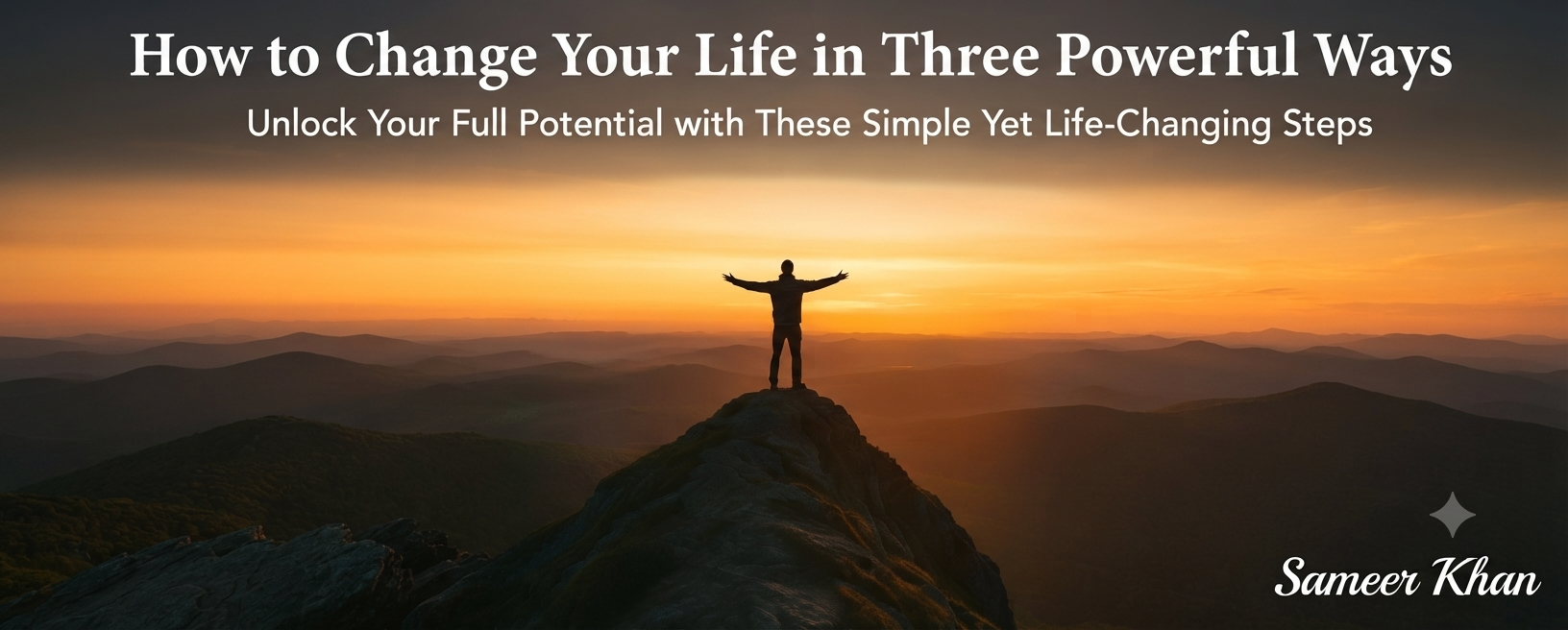
There comes a moment in life when you realize that something has to change.
Maybe you're tired of wasting time. Maybe you keep starting things but never finishing them. Maybe you feel stuck in the same routine, surrounded by the same problems, with the same excuses repeating in your head.
You want a different life—but you don't know where to begin.
The good news is that you don't need to change everything overnight.
You need to change what you do every day.
Your life is largely the result of your repeated thoughts, decisions, habits, relationships, and actions. Change those consistently, and your life can gradually become almost unrecognizable.
If you genuinely want to know how to change your life completely, start here.
1. Be Honest About Your Current Life
Before you can change your life, you have to accept where you are.
Don't blame your past forever. Don't pretend everything is fine when it isn't. And don't make excuses for habits that are clearly hurting you.
Take some time to honestly evaluate your current situation.
Ask yourself:
-
Am I happy with the person I am becoming?
-
Where am I wasting most of my time?
-
What habits are holding me back?
-
What am I avoiding?
-
What do I keep saying I will do but never actually do?
-
What would I change if I knew I couldn't fail?
-
What would my life look like if I continued living exactly the same way for another five years?
Write your answers down.
You cannot solve a problem you refuse to acknowledge.
Sometimes the first step toward changing your life isn't taking action.
It's finally telling yourself the truth.
2. Decide What You Actually Want
A common reason people feel stuck is that they want their life to improve but don't know what "better" actually means.
Instead of saying:
"I want a successful life."
Be specific.
Maybe you want:
-
Better health
-
Financial independence
-
A successful business
-
A better career
-
Stronger relationships
-
More confidence
-
More discipline
-
Less stress
-
More freedom
-
More time for yourself
-
Better mental focus
-
A stronger sense of purpose
You don't have to improve every area simultaneously.
Choose the areas that matter most right now.

Your goal doesn't need to be a perfect five-year plan. You simply need a direction.
When you know where you want to go, your daily decisions become easier.
3. Stop Waiting for Motivation
One of the biggest mistakes people make when trying to change their lives is waiting to feel motivated before taking action.
Motivation comes and goes.
Discipline is different.
You won't always feel like exercising, studying, working, reading, building a business, or doing something difficult.
If you only act when you feel motivated, you'll remain inconsistent.
Instead, create a simple rule:
Do it even when you don't feel like doing it.
Start small.
Read five pages.
Walk for ten minutes.
Work for twenty-five minutes.
Write one paragraph.
Complete one important task.
Small actions build momentum.
And if procrastination is one of the biggest things stopping you from taking action, read our guide on how to stop procrastinating when you're overwhelmed. Learning how to break overwhelming tasks into smaller actions can make it much easier to get moving.
4. Change Your Daily Routine
If you repeat the same routine every day, you will probably continue getting similar results.

You don't need an extremely complicated morning routine.
You need a routine that helps you become productive, focused, and consistent.
For example:
Morning
-
Wake up at a consistent time.
-
Drink water.
-
Avoid immediately checking social media.
-
Exercise or walk.
-
Decide your most important task.
-
Start the day intentionally.
Day
-
Work on your highest-priority task first.
-
Take regular breaks.
-
Avoid unnecessary distractions.
-
Eat reasonably well.
-
Keep learning.
-
Finish important work before unnecessary entertainment.
Evening
-
Finish unfinished important tasks.
-
Reduce unnecessary screen time.
-
Review your day.
-
Prepare for tomorrow.
-
Go to bed at a consistent time.
Your routine doesn't need to look impressive.
It needs to be repeatable.
A simple routine you follow for months is more powerful than a perfect routine you abandon after three days.
5. Remove the Habits That Are Destroying Your Time
Changing your life isn't only about adding good habits.
Sometimes you need to remove bad ones.
Think about how much time you spend:
-
Scrolling social media
-
Watching random videos
-
Checking your phone repeatedly
-
Complaining
-
Comparing yourself to others
-
Staying up unnecessarily late
-
Procrastinating
-
Constantly consuming entertainment
-
Thinking about doing something instead of doing it
You don't have to eliminate everything you enjoy.
But you should become conscious of what consumes your time.
A few wasted minutes don't seem important.
Repeated every day, they become years.
Ask yourself:
"If I continue spending my time this way for the next five years, will I be happy with the result?"
If the answer is no, something needs to change.
6. Learn to Keep Promises to Yourself
Self-confidence doesn't only come from achievements.
It also comes from trusting yourself.
Every time you tell yourself, "I'll do it tomorrow," and don't, you teach yourself that your own promises don't matter.
This is why building self-trust is such an important part of changing your life.
If this is something you struggle with, read how to stop breaking promises to yourself and build self-trust. Keeping small commitments to yourself can gradually rebuild your confidence and make discipline easier.
Start making smaller promises.
Instead of:
"I'll exercise for two hours every day."
Say:
"I'll walk for 20 minutes today."
Then do it.
Instead of:
"I'll completely change my life starting tomorrow."
Say:
"I'll spend 30 minutes working on something important today."
Then keep that promise.
Self-discipline grows when you repeatedly do what you said you would do.
7. Take Care of Your Body
You cannot completely transform your life while completely ignoring your physical health.
Your body affects your energy, concentration, confidence, productivity, and ability to perform throughout the day.
You don't necessarily need an expensive gym membership or a complicated diet.
Start with the basics:
-
Get enough sleep.
-
Move your body regularly.
-
Eat more nutritious foods.
-
Drink enough water.
-
Reduce excessive junk food.
-
Spend some time outdoors.
-
Maintain a healthy body weight.
-
Give your body enough time to recover.
The goal isn't perfection.
The goal is to make your body support the life you want to build.
When you have more energy, it becomes easier to work, learn, exercise, and stay consistent.
8. Protect Your Attention
Your attention is one of your most valuable resources.
Every notification, short video, unnecessary argument, and random piece of content competes for it.
If you constantly consume other people's lives, opinions, and entertainment, you may have very little attention left for building your own life.
Try creating periods of uninterrupted focus.
Put your phone away.
Close unnecessary tabs.
Turn off notifications.
Work on one thing.
Even 30 minutes of focused work can be more valuable than several hours of distracted activity.
Your phone isn't necessarily the problem.
Your inability to control your attention is.
Learn to decide what deserves your attention instead of allowing everything around you to decide for you.
9. Stop Comparing Your Life to Other People
Social media can make it seem like everyone else is ahead.
Someone has a better job.
Someone bought a house.
Someone started a business.
Someone is travelling.
Someone looks more successful.
Someone appears to have everything figured out.
But you're usually comparing your entire life to someone else's highlight reel.
You don't see their failures, doubts, financial problems, relationship problems, or difficult days.
Your journey is different.
Instead of asking:
"Why am I behind them?"
Ask:
"Am I better than I was six months ago?"
Your real competition is the person you were yesterday.
Measure your progress against your own previous version.
10. Surround Yourself With Better Influences
The people around you can influence your thinking, habits, ambitions, and standards.
You don't need to abandon everyone who isn't successful.
But pay attention to the conversations you repeatedly participate in.
If your environment constantly encourages:
-
Negativity
-
Laziness
-
Complaining
-
Destructive habits
-
Excuses
-
Small thinking
it becomes harder to build a different life.
Look for people who encourage:
-
Growth
-
Responsibility
-
Learning
-
Discipline
-
Action
-
Ambition
-
Healthy habits
And if you can't find those people around you, learn from books, podcasts, courses, mentors, and positive communities.
You don't have to physically live around successful people to learn from them.
Your environment matters—but you can intentionally build a better mental environment too.
11. Build One Valuable Skill
If you want your financial and professional life to change, become valuable.
Learn a skill that people or businesses are willing to pay for.
Examples include:
-
Writing
-
Sales
-
Digital marketing
-
Programming
-
Video editing
-
Graphic design
-
Copywriting
-
Communication
-
Data analysis
-
Search engine optimization
-
Business development
Don't try to master ten skills simultaneously.
Choose one.
Practice it consistently.
Build projects around it.
Get feedback.
Improve.
Then find ways to turn the skill into income.
A valuable skill can change more than your career.
It can change your confidence, opportunities, network, independence, and understanding of what you're capable of achieving.
12. Get Comfortable With Being Uncomfortable
A better life often requires uncomfortable decisions.

You may have to:
-
Wake up when you want to sleep.
-
Work when you want to procrastinate.
-
Say no when you want to please everyone.
-
Start something when you're afraid of failing.
-
Leave situations that are holding you back.
-
Have difficult conversations.
-
Try again after failure.
-
Take responsibility when blaming someone else would be easier.
Growth often happens outside your comfort zone.
Being uncomfortable doesn't automatically mean you're doing the right thing.
But avoiding every difficult thing guarantees that you'll remain stuck.
Learn to distinguish between useful discomfort and unnecessary suffering.
Sometimes discomfort is simply the price of becoming stronger.
13. Stop Trying to Change Everything at Once
This is extremely important.
You might read this article and suddenly decide:
"I'll wake up at 5 AM, exercise two hours, read 50 pages, start a business, learn coding, meditate, quit social media, and completely change my life tomorrow."
You might last three days.
Then everything collapses.
Why?
Because you tried to replace your entire lifestyle overnight.
Instead, change gradually.
For the next 30 days, focus on a few fundamentals:
Sleep better.
Move every day.
Work on one important goal.
Reduce unnecessary screen time.
Keep your promises to yourself.
Once these become normal, build from there.
And if you frequently start something with enthusiasm only to abandon it later, read how to stop quitting everything you start. Learning how to continue after the initial excitement disappears is an essential part of long-term change.
Consistency beats intensity.
14. Build Discipline Instead of Depending on Motivation
There will be days when you feel inspired.
There will also be days when you don't want to do anything.
Your ability to continue on those ordinary days is what separates temporary motivation from real discipline.
If you're struggling specifically with motivation, read how to build self discipline when you have no motivation. It explains how to take action even when you don't feel ready or motivated.
You can also learn more practical techniques in how to be self-disciplined: 10 practical ways to build discipline.
Discipline isn't about becoming a robot.
It's about making important decisions before your emotions get a chance to negotiate with you.
15. Learn How to Stay Consistent
Starting is exciting.
Continuing is harder.
Anyone can make a new plan on Monday.
The real challenge is following that plan when Monday becomes Tuesday, Tuesday becomes Wednesday, and the excitement disappears.
Consistency doesn't mean performing perfectly every day.
It means returning to the path when you slip.
You may miss a workout.
You may waste an afternoon.
You may procrastinate.
You may have an unproductive day.
That's okay.
Don't turn one bad day into one bad month.
If consistency is something you're actively working on, read how to maintain consistency and discipline: 9 practical strategies for practical ways to keep moving forward.
Remember:
Missing once is a mistake. Giving up completely is a decision.
16. Create a 90-Day Goal

You don't need to know exactly where you'll be ten years from now.
Focus on the next 90 days.
Choose one major outcome.
For example:
Health
Become more active, improve your eating habits, and work toward a healthier body.
Career
Learn a valuable professional skill and build a portfolio.
Business
Launch your first product or service.
Personal Development
Build a consistent daily routine and improve your discipline.
Then break your goal into weekly actions.
Every Sunday, ask:
-
What did I accomplish?
-
What didn't I accomplish?
-
What distracted me?
-
What did I learn?
-
What should I change next week?
-
What is the most important thing I need to accomplish next?
This turns vague motivation into measurable progress.
17. Make Your Environment Work for You
Willpower is useful, but your environment can make good decisions much easier.
If your phone is next to you, you'll probably check it.
If junk food is always available, you'll probably eat it.
If your workspace is chaotic, focusing can become harder.
If your book is visible and your phone is somewhere else, reading becomes easier.
Design your environment around the person you want to become.
Want to read more?
Keep a book where you normally use your phone.
Want to exercise?
Keep your workout clothes ready.
Want to spend less time on social media?
Remove distracting apps from your home screen.
Want to focus?
Create a dedicated workspace.
Don't make every good decision depend on willpower.
Make good decisions easier.
18. Stop Letting Your Past Define You
Your past can explain where you came from.
It doesn't have to determine where you're going.
Maybe you've wasted years.
Maybe you've made bad decisions.
Maybe you've quit many times.
Maybe you've disappointed yourself.
Maybe you've started over repeatedly.
That doesn't mean you're incapable of changing.
Your past is already written.
Your next chapter isn't.
Instead of constantly asking:
"Why did I become this way?"
start asking:
"What can I do differently from today?"
You don't need to erase your past.
You need to stop using it as a permanent excuse.
19. Accept That Your Old Life May Have to End
Sometimes changing your life means letting go of an older version of yourself.
The person who constantly procrastinated may have to become someone who takes action.
The person who always quit may have to become someone who finishes.
The person who constantly sought approval may have to become someone who trusts their own decisions.
The person who wasted years may have to stop using the past as an excuse.
The person who constantly said "tomorrow" may have to learn to act today.
You don't have to hate your old self.
That version of you got you here.
But you don't have to remain that person.
Growth means allowing yourself to become someone new.
20. Start Before You Feel Ready
You may never feel completely ready.
You may still be afraid.
You may still have doubts.
You may still feel inexperienced.
You may still wonder whether you'll succeed.
That's normal.
If you wait until you're completely confident, you may wait forever.
Confidence often comes after action, not before it.
Start with what you have.
Learn as you go.
Make mistakes.
Improve.
Try again.
Your first attempt doesn't have to be perfect.
It simply has to exist.
You Can Start Today
You don't need Monday.
You don't need January.
You don't need a new year.
You don't need more motivation.
You don't need to have everything figured out.
You need one decision and one action.
Clean your room.
Go for a walk.
Write down your goals.
Delete one distracting app.
Study for 30 minutes.
Apply for one opportunity.
Start the project you've been postponing.
Have the conversation you've been avoiding.
Finish something you started.
Do something today that your future self will thank you for.
Don't underestimate one productive day.
One productive day can become a productive week.
A productive week can become a productive month.
A productive month can become a completely different year.
A Simple 30-Day Life Reset
If you don't know where to start, keep it simple.
For the next 30 days:
Every morning: Decide your most important task.
Every day: Move your body.
Every day: Spend at least 30 minutes working toward your most important goal.
Every day: Limit unnecessary scrolling.
Every day: Keep at least one promise to yourself.
Every evening: Review what you accomplished.
Every week: Identify what worked and what didn't.
Don't try to become a completely different person in 30 days.
Become someone who can trust themselves to take consistent action.
That is a much more powerful transformation.
Final Thoughts
Changing your life completely doesn't happen in one dramatic moment.
It happens through hundreds of small decisions.
You wake up and choose discipline instead of comfort.
You choose action instead of procrastination.
You choose learning instead of endless entertainment.
You choose progress instead of perfection.
You choose consistency instead of constantly starting over.
You choose to keep going when the initial excitement disappears.
One day, you look back and realize that your life changed—not because of one massive decision, but because you stopped living the same day repeatedly.
You don't need to change your entire life today.
Change what you do today.
Then do it again tomorrow.
And again the next day.
Eventually, those ordinary days will create an extraordinary life.
Your life doesn't change when you simply want something different.
It changes when you consistently do something different.
Comments (0)
No comments yet. Be the first to share your thoughts!